
Monday, May 26, 2008


Sunday, May 25, 2008
Roadside Produce
It is good to learn your lessons early. Don't plant the warm season vegetables until it is warm! Like closer to Memorial day or when you actually wear shorts for the first time since last year.

The melons that succumbed to hypothermia have been replaced and low and behold, with highs in the low 70's and the lows around 50, all the other warm season vegetables are looking much perkier. It is like they have a reason to live now.

Is it strange that after all these years I can still get excited about the first produce from my garden?

I was used to plucking avocado and oranges from my trees and now I am excited by radishes. The blueberry bushes are looking like they will have a good crop. We just have to outsmart the birds at the right time.
Coming and Going
I have to come down from the mountain

For supplies, now and again.

The road I travel is a designated Scenic Byway.

I stopped today to capture some of the scenic.

This makes up for the horrors to be seen and heard at a Walmart in Waynesville on a Sunday.
Oh..My..Gawd!
And I am not just talking about the Holy Roller rock-n-roll band jamming in front of the store and the groupies handing out flyers for Jesus.
Friday, May 23, 2008
When Land Hands You Rocks
.
Build Monuments.
My Blogger icon was dressed up for Gardening Gone Wild's Design Workshop, 'Stone in the Garden' with the lei I was given on my departure from Maui on June the 4th 2007. The lei drove cross country with me and has remained on the dashboard of my truck all this time. A good lei can last for a long time; if it stays dry.

I lived on the volcanic island of Maui for twenty years. Coming from the flat lands and deep sands of Florida, the mountainous rocky terrain, that went from sea level to the 10,000 foot summit of Haleakala was an exciting new world. I went there to visit a friend and as a graduation present to myself from college. I had just gotten a Bachelor of Science degree in Ornamental Horticulture. I stayed for twenty years to garden.
Rocks were everywhere. The whole island was made of volcanic rock. Dealing with rocks was such a part of gardening it became almost unnoticeable. The easiest and most common method to accommodate all the rocks was to just bury them. That took care of most, but some always managed to stay on the surface. Another avenue was to use the rocks for edging. This was not wholly unattractive. They belonged and created a sense of place. Rocks as edging are a maintenance headache though. They eat weedeater line and are difficult to keep clean without resorting to glyphosate. The rich built walls with rocks they paid for, generally after bulldozing and burying the ones on site.
I had other ideas.

The cottage I rented for sixteen and a half of those years was brand new when I moved in. The land was virgin leeward Maui, a dry savanna grass and scrubland, littered with rocks. I didn't want to edge my beds with rocks. I piled them up into one great big Pile O' Rocks. Visitors to my garden always stopped when they saw my Pile O' Rocks.
It took two years to stack because the rocks were gathered as the land was prepped and a garden was planted. The dry stacked heiau/pyramid in my garden has stood for fourteen years. It will last long after I have been gone unless someone deliberately dismantles it. Not many people have that kind of interest or energy. I expect that future visitors to this cottage will stop and wonder when they see this Pile O' Rocks.

The last landscape design and installation job I completed only a couple months before my departure was a particularly difficult site. In essence it was a steep rocky cliff face with a small relatively level portion at the top that comprised about one third of the lot. The second to last portion of the landscape installed after all the construction was completed was the steepest section of the lot. There were an inordinate amount of rocks on this site from fill brought in, from major retaining wall construction and the natural land itself. It was my final project on Maui and there were several tons of loose rock that needed to be dealt with. I had an idea.

I would build another Organized Pile of Useless Rocks. Why should my soon to be former garden be the only one on Maui with such a unique structure.

In this garden it would make a strong focal point

At a major intersection and dividing point between the main house and the rental cottage.

Just in case, you know. Having a backup is a good idea.
Christopher C. was here!

So the normal average person is going to ask, "Why would you leave Maui?" with a tone of incredulity. Well there were a lot of reasons. The major contributing factor was an offer of an early inheritance of land if I would come back to live on the land. After decades of being a tenant, I was more than ready to own the land where I planted my garden.
When I arrived in the mountains of Western North Carolina to the place I would now call home, the trackhoes had already begun the work of clearing the land for a road and house pad.

The trackhoe guys said this site was like digging in a potato field. There were so many rocks. From my experience on Maui I saw way more soil than rocks and told them so. "This ain't nothin" I said. I did see Plenty O' Rocks and to me that was a good thing. I had no idea at the time what I might make with them. I just knew they would be put to use.

The idea of parking a small camping size trailer on the house pad for an instant home was soundly rejected. Building a small cabin that could become a guest cottage in the future became the main task. It was located on the slope off to the left of the driveway and forward of the future house site. Standing underneath the cabin floor one day in the rain I had an idea about what to do with all the space beneath it. It involved rocks.

The severity of the slope made this large covered space close to unusable. Even if it was used to store collectibles, something would have to be done to create a level space for storage. Peering out towards my future gardens between the massive architectural concrete columns during the rain, a semi-covered patio was born. All I needed was a couple of retaining walls to terrace the slope. The stones that littered the ground now had a purpose.
Initially I thought I would build a mortared wall. I thought it would be a stronger retaining wall. A probably subpar, for that type of wall, steel re-enforced concrete footing was poured. Then fate intervened and I met a local stone mason, David Reed at my first clients. We chatted and I read one of his books, The Art and Craft of Stonework. The wall was now going to be dry stacked.

A dry stacked wall has the advantage of being totally open to drainage. This makes them far less susceptible to freeze thaw damage and hydrostatic pressure that can build behind a wall. They are more flexible and can move without cracking or falling apart. They are easier and cheaper to build, easier to repair if needed and being that I am not a stone mason, if it turned out hideous, it wouldn't be set in concrete.

Landscape fabric was placed over the soil behind the wall to prevent the dirt from moving into the wall and slowing drainage. As the wall rose it was back filled with gravel in front of the fabric. The gravel helps lock the stones in place and aids in drainage.

This first wall went up pretty quickly. I had been sorting and storing rocks for some time as I gardened around the edges of the property and built the foundation and floor of the cabin. Most of the stones were uphill and close by.

For the second retaining wall and to complete the terrace for a level patio floor, I was going to have to collect rocks a bit farther afield.

First I had to dig out the back slope. The patio would be half under the cabin and half in open air. I would be able to change sitting locations on the patio depending on the weather conditions.

This time a trench filled with gravel was used as the footing for the wall. A short dry stacked wall does not need a concrete footing. This same gravel base will extend to the front retaining wall and be used down the road for a stone floor.

The same method is used of placing fabric over the soil and back filling the wall with gravel as it rises. Let the stacking begin.

A conscious effort to slow down while building this second wall, enhanced by having to fetch the stones from much further away is giving this second wall tighter seams and a more polished look.

As polished as a wall made from fieldstone found on site can look.
If Michelle Derviss at Garden Porn does a post on Stone in the Garden for this workshop, you will get your rocks knocked off.

These are not fancy, store bought, dressed stone.

Two walls and landings and steps on both sides that will transition back into the slope are being fashioned from the rockpodge this land gave me.
There is a cabin that needs to be built as well. The walls have taken a back seat for now. The lower wall still needs the top to be polished off. The upper wall under the cabin has about another foot and a half to go. A roof over my head takes precedence.

There is another stone project in the contemplation phase. The boulders that were too big to tote up the hill for the walls lay in wait.

At one point I saw them as a snake in the grass. I think that has changed. They are too irregular in size and shape to sculpt a credible snake, at least to my satisfaction. The "grass" grows too tall and a short slithering snake will be lost. I need something more monumental, something that stands out. Will it be another heiau/pyramid or will it be something else? I'm thinking.

What ever these stones become they will be viewed from above. The Nazca Lines have a certain appeal.

There is no shortage of rocks on this land. There is no shortage of time. This is where I plan to stay until the end.

A patio made of stone takes shape under a small cabin gaining form.

The Beginning.

Wednesday, May 21, 2008
Two Rhodos
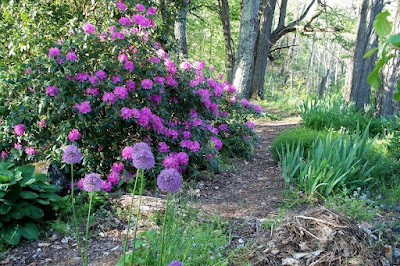
Something pretty to look at

While I gather all the pictures for my Gardening Gone Wild Design Workshop post
On stone in the garden. It could be a long post for me and might take a few days.

While I gather all the pictures for my Gardening Gone Wild Design Workshop post

On stone in the garden. It could be a long post for me and might take a few days.
Tuesday, May 20, 2008
Acquisitioned
I have scheduled myself to work for my clients two days a week as a minimum. Between the four properties this represents, I could and do work a bit more. Today I was at the flower bed restoration and reduction project for Client #2. This garden is being reduced in size by 50%. The idea is to make it more manageable for part time gardening. The rest will be turned over to the lawnmower dude.
The Lupines in this garden let go, are just beginning to bloom. They are pretty big plants. The top of the foliage is about two feet. These are the real thing, not the southern replacement, Baptisia. I may be able to grow both.
Sadly there were four offspring of these Lupines in the soon to be lawn.

So I decided to move them.

To my garden across the street.

The skies were getting dark and rolling thunder rumbled close by. Right after I finished planting the new Lupines it began to spit rain. By the time I got to the house the skies opened up. It poured. It hailed a little. There was a lot of lightning. The new Lupines got a good deep drink.

There is still a lot of slope to cover. I have been eyeing this thick patch of Iris along the stream in the upper sunny utility meadow.

When it is done blooming, I think I will acquisition some of it too.
Monday, May 19, 2008
The Hunt For Showy Orchis
The story goes, a Showy Orchis, Galearis spectabilis, one of the native orchids lives half way to two thirds of the way down one particular slope. It, not them, blooms in May. Now is the time to look for this pink and white flowered orchid in a forest filled with the rosy pink Geranium maculatum in bloom. Timing is everything. Will I be able to find it?

Not an orchid, but a parasitic perennial herb, Squaw Root, Conopholis americana favors Oak trees as a host. The leaves have been reduced to small brown scales. The flower stems do not emerge from the ground. The flowers themselves do not open. They self pollinate and produce seed completely underground. Now how odd is that?

Crisscrossing the slope at different levels I look for a different leaf, a different flower. I look in open areas and underneath groves of small trees.

I see plenty of the Bloodroot, Sanguinaria canadensis. It has a nice leaf shape.

I even find Turk's Cap Lily, Lilium superbum. Some of these need to be moved to the roadside bed behind the split rail fence. Their height of up to six feet would work behind the fence and they are far more likely to bloom in more sun, than they will in the deep shade of the forest.

Some where in here there may be a Showy Orchis, unless a big tree fell on it and it is hidden under a big log now. I'll have to keep looking.

Let the carnage begin. The cantaloupe seedlings look very thirsty. It has rained more than enough, plenty, and I watered them and still they wilt. The tomatoes, cucumbers, peppers and squash look fine. What is wrong with the melons?

The wilting basil on the deck at the resident gardeners gives me a clue. It has rained more than enough, plenty, and I watered them and still they wilt. I have a distinct feeling there are some herbs and warm season produce that strongly resent temperatures in the upper thirties and low fourties. I think they are dying of hypothermia. A rush to plant may have killed them. Oh well, there is time to plant more, when and if the lows ever make it out of the low fourties.

There are happy plants on the mountain. The Eremurus, Foxtail Lily has buds. These were overflow from one of Bulbarella's catalog orders that ended up in my garden. All six rootstocks finally came up. The smaller one appeared about six weeks after this first one now in bud.

The finished Tulips in the front bed are well hidden by the Daylily foliage. All the plants from last year except two Centaurea survived the winter. The survivors are waiting for the real warmth to take off. It has been cool up here and that makes an impact on what will grow.

There is enough to keep me occupied while I hunt for the Showy Orchis.
Subscribe to:
Posts (Atom)



 Posts


