Tuesday, April 8, 2014

What Will The Garden Do

So far this week an Ostrich Fern


And a native Virginia Bluebell have followed me home. I am a plant magnet whether I make any effort or not. All kinds of plants follow me home and I find a place for them some where in the wild cultivated gardens. Most stay close to me, but with three acres to work with they can also end up in the far reaches of the ridge top garden and in the sunny utility meadow.


I don't always remember where things get planted out there in the vast expanse. The awakening of spring always has some surprises, particularly with the bulbs and herbaceous perennials. Add in copious seed flinging and who knows what will come up. The trees and shrubs are much easier to keep track of.


I go out there hunting, scanning the ground closely to see what is coming up. I know I planted this. Where did I plant it? I know I planted this here. Where is it? Is it not awake yet or is it not coming back? What is that? Did I plant something here?

I try to stick to the paths. This is the wrong time of year to be stomping through the beds.


The mystery of what the garden will do from my constant additions and faulty memory are abetted by nature's rambunctiousness. A lot of plants around here simply don't stay put. They move about and multiply. There are two native Dicentra species here. I am not in control of them at all. They go about their business. I let them be.


The gardeners abet nature by adding other plants that like to run wild. The minor bulbs chionodoxa and puschkinia have reached a critical mass and the multiplication has begun to get exponential.


Natives can do that too. It is hard for me to imagine that ramps could be getting scarce after watching them multiply with abandon over the years. This patch was just a few plants six years ago.


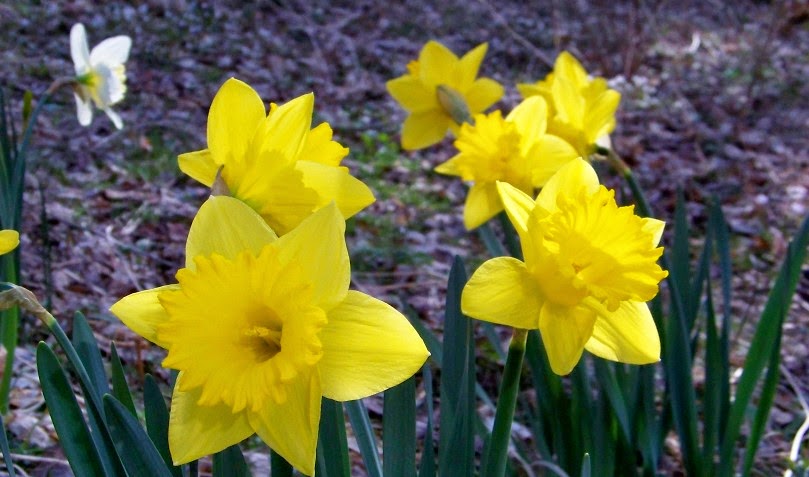
The Bulbapaloozathon should be peaking by this weekend when it warms back up again. The daffodils are having a much better year than last when the bloom was off. Rot was about and bulb flies were discovered. They were not happy last year.


I have seen signs of the daffodils self sowing, but they don't do it much. Multiplication comes largely from division. It finally dawned on me why I thought some of the bulbs had been disappearing. When a clump gets big enough to suit her, Bulbarella digs the whole thing up and spreads them around. She always misses a few bulbs so she doesn't bother to replant the same hole. Some times there are only remnants left. Where I thought a big clump had been only a few sprigs may remain.


I can't keep track of all that.


There are multiple forces at work in the wild cultivated gardens that mean I really have no idea what the garden will do from one year to the next. The abundance tends to insure that whatever happens it will be be more than fine and often quite extraordinary.

Sunday, April 6, 2014

Spring Deep Pink

Blue Bottles


Black Helleborus


Saturday, April 5, 2014

A Stroll In The Wild Cultivated Gardens

I started my day with the first planting and sowing in the roadside vegetable garden. Two rows of potatoes were planted, yellow and red. My soil gets fluffier and fluffier every year. Seven years of wood chip mulch decomposing on top and now additions of great dollops of dung do wonders. The shallow rock filled soil with a hardpan below is nearly no more.


I sowed spinach, three kind lettuce, carrots, parsnips, beets and sugar snap peas. A bunch of Gloriosa Daisy and Black-Eyed Susan were transplanted out of the garden and into the wild flower strip along the rickety split rail fence. Rain is scheduled for tomorrow night and Monday.

The best news is there has been ample opportunity and conditions for any weed seed in the manure to germinate and I am seeing nothing so far. I hope it stays that way.


After a few more chores it was time to amble through the wild cultivated gardens to see what else was waking up and enjoy all the blooms.

Many of our weeds bloom and they bloom in abundant profusion. That characteristic moves them out of the weed category and into the wild flower category. We let them be.

Spring Beauty, Claytonia virginica is a petite little plant. It is not petite in numbers.


There are daffodils of course, new varieties opening daily.


Three of my botanical garden plant sale trilliums have awaken so far. I haven't seen the local wild trilliums yet.


The mass of Anemone blanda grows fuller by the day.


The wild Anemone acutiloba does not shrink in comparison. Down in the forest it covers up to half an acre.


The flower is a bit smaller, but in the dappled light of the forest, the pure white stands out.


I found the first Bloodroot, Sanguinaria canadensis. Hundreds more will follow in the coming weeks.


Species tulips from last fall's bulb purchase evaded the varmints to put on a nice display. There are a few poisonous to varmints daffodils planted among them.


There are other kind daffodils of course.


The catalog bought pink Trout Lily is having a good year. There is a yellow catalog bought one also. Both of them seem to multiply generously but they have been fighting off something that likes to chew on them. I think the yellow one moved two feet from the original planting site to try to get away.


There are a whole lot of daffodils of course. I expect they will be peaking in volume of bloom by next weekend.


Daffodils from stem to stern and top to bottom.


These are the store bought trilliums I really want, a bright yellow and a deep red with mottled leaves. Multiplication has been slow going for them. I'd be happy to buy some, but trilliums just are not something you see in nurseries very often.

The nine species of trillium I have gathered into the garden becoming will do for now, until I find a source for more.


That is a good sample of what is blooming in the wild cultivated gardens in early April. There is more of course. Much more.

Friday, April 4, 2014

Spring Thievery

Buds are breaking. Trees are blooming. Spring is in full swing down below.


In places the burst of color is beyond dramatic.


In places I tend.


I stumbled upon two steep hillsides that are vacant lots or common area that were covered with thousands of Trout Lilies, Erythronium americanum, in my tending today. Thousands I tell you. I had to have some.


I dug up a big sack full and relocated them to three different gardens that did not have the native Trout Lily. Now they do. They grow from a small bulb so I expect they should transplant well even if the tops die back sooner than normal.

I planted mine in three different locations in the garden becoming. The garden is well on its way to having a very strong native spring wild flower display. I may relocate some Anemone acutiloba over here tomorrow.


I see no reason not to have the native spring wild flowers mixed in with the bulbs.


More is better. More leads to abundance.

Thursday, April 3, 2014

In The Course Of My Day

I leave home in the morning to go tend gardens that more often than not are filled with flowers all season long.


I come home to a garden that has many flowers all season long that are not often found in the gardens I tend. We have to look again while the Oconee bell is blooming.


Sometimes I get home early enough to squeeze in a chore before supper. I started tidying the roadside vegetable garden last week to get it ready for the first sowing. Then it snowed and the first sowing was cancelled.

Today all the dead remnants of the front row of perennial wildflowers that had been raked into piles were dry enough for a burning. I burned that up then gave the posts of the rickety split rail fence a straightening and lifted a lot of the rails. After a long winter of snow getting plowed against the fence it struggles to cling to the status of a fence.

I don't hate this fence. It's rustic character has a certain charm. It's old bailing wire construction and half rotten posts is another matter. One day it must be replaced.


I have a vague plan. I want to assert more control over what grows in the wild flower strip between the fence and the vegetable garden. It was dominated by goldenrod and marjoram gone wild and had a short single late season bloom. I want more color and more bloom over a longer period. Once it turns green I'll spray it, saving the good stuff, then plant more. I'll have to try poppies again.


After supper it's time for a stroll in the ridge top garden next door. What will be blooming today?


The minor bulbs are getting more numerous every year.


And in many more places.


And several days of a touch too warm really, have opened hundreds of daffodils.


That's pretty much an average day for me.

Wednesday, April 2, 2014

The First Hint Of Abundance

The light fades at the end of another warm spring day. A patch of vibrant yellow daffodils becomes a beacon in the dim barren forest. Something grows here.


With each warm day, that bright promise of life grows stronger.


But there is much more than what thousands of yellow daffodils can herald. Just come close and look. The native Oconee Bell has its first flowers in its new home.


Other bright colors welcome you to enter the forest.


To find masses of the minor bulbs. The deep blue of chionodoxa.


Or the palest of blues in the puschkinia.


There are pink Trout Lilies to be found when you enter the forest and look close.


All this and more as each day passes, mingled in with 10,000 daffodils.


The abundance is returning.

Tuesday, April 1, 2014

The Daffodils Begin

The daffodils have responded to the warm seventy plus degrees.


They are not alone. The Anemone blanda sprinkles the sunny utility meadow with cheery blooms in lavender hues.


She never stops trying. The first of the catalog bought species tulips have arrived. Will planting them with the poisonous daffodils deter the bulb eating varmints? And for how long?


There are close to three acres of wild cultivated gardens out there. The daffodils have just begun so there are no masses of color to see from a distance just yet. You must stroll the grounds to get a closer look. That is really the whole point.


As the warm days add up 10,000 daffodils will come into bloom. The good news is I am not seeing all the rot and distorted and discolored leaves in them that I saw last year. The daffodils are looking much better this year. The show will go on.

I still plan to fertilize them with a systemic pesticide add on after the bloom is over again this year. I'm gonna decimate me some daffodil bot fly.